A board in a Boca Raton condominium can send an owner a bill for $50,000 or more with thirty days to pay the first installment. That is not a hypothetical. It is the mechanical result of a state law that finished phasing in eight months ago, and it is quietly rewriting what "median price" means for anyone comparing condos in this city.
Here is the number that should stop a buyer mid-scroll: in the twelve months ending August 2026, the median list price for a house in Boca Raton climbed from roughly $1,049,450 to $1,399,000, a jump of about 33 percent. Over the same window, the median list price for a condo or co-op in Boca Raton actually slipped, from about $359,250 to $349,950. One property type in this city got dramatically more expensive. The other got slightly cheaper. That is not softness. It is a fracture, and the fracture has a name: Senate Bill 4-D.
The Bill That Arrives After You've Already Fallen in Love
Florida passed its post-Surfside structural safety laws in 2022, refined them with House Bill 913 in 2025, and gave condo associations a grace period to comply. That grace period for completing a Structural Integrity Reserve Study, the engineering-backed analysis of what a building's roof, load-bearing walls, plumbing, and waterproofing will cost to maintain, ended December 31, 2025. Unless a building's SIRS is tied to a milestone inspection due by the end of 2026, the deadline has already passed.
What that means in practice: associations that spent decades voting to waive reserve funding, a common practice for keeping monthly dues low, can no longer do it for structural components. Many are now closing the gap with special assessments in the range of $25,000 to well over $100,000 per unit, because the alternative is violating state law and exposing the board to fiduciary liability. The raised statutory reserve threshold itself tells the story. Florida moved the mandatory funding trigger for reserve line items from $10,000 to $25,000, with the state's official 2026 adjusted figure landing at $25,675.
If you are shopping for a condo in Boca Raton right now, this is the friction that surfaces during a transaction, not before it. A listing can look identical to the one next door on price per square foot and still carry a very different bill waiting in the association's file cabinet.
Boca Raton's Clock Runs a Little Faster
Most of Florida treats a building's 30th birthday as the trigger for its first milestone inspection, or 25 years if the building sits within three miles of the coast. Boca Raton is unusual because most of the city actually falls inside that three-mile coastal band, which pulls the bulk of its condominium stock east of I-95 onto the earlier, 25-year clock rather than the standard 30.
The city also runs its own local enforcement layer on top of the state statute. On August 24, 2021, the Boca Raton City Council adopted Ordinance No. 5589, establishing the city's Building Recertification Inspection Program. It applies to condominium or cooperative buildings three stories or taller, charges a $500 review fee per recertification, and the city is currently working through a recertification backlog scheduled to run from 2027 through 2031. That backlog matters for buyers: a building's place in that queue can tell you whether its inspection, and any resulting assessment, is imminent or still years out.
Boca Raton's mix of 1970s, 1980s, and 1990s oceanfront towers makes this more than a paperwork exercise. Buildings from that construction boom are now 30 to 40 years old, hitting their milestone deadlines at roughly the same time, in an environment where salt exposure along A1A and the Intracoastal accelerates corrosion of reinforcing steel faster than it would inland.
Two Boca Ratons, One Median
Line up what's actually selling and the split becomes obvious.
| Older Oceanfront Stock | New Construction | |
|---|---|---|
| Era | 1970s to 1990s condo boom | Delivered or under construction now |
| Examples | Addison On The Ocean, Admiral's Walk, The Aragon, Ocean's Edge | Alina Residences, Glass House Boca Raton, 327 Royal Palm, Tower 155 |
| Price signal | Price reductions of 5 to 8 percent from 2023 peaks in older complexes, as tracked in mid-August 2026 | Premium towers pricing from roughly $2.3 million to $2.5 million at the median, as of late 2025 |
| What's driving it | SIRS deadlines, special assessments, reserve underfunding | No legacy reserve gap; buyers pay for structural certainty upfront |
Earlier in 2026, some market commentary pointed to corrections as steep as 20 to 30 percent in certain older, non-waterfront buildings. The more recent mid-August tracking of 5 to 8 percent suggests that estimate was either building-specific or has moderated as the market absorbed the first wave of assessments. Either way, the direction hasn't changed: older stock is repricing downward while new construction isn't.
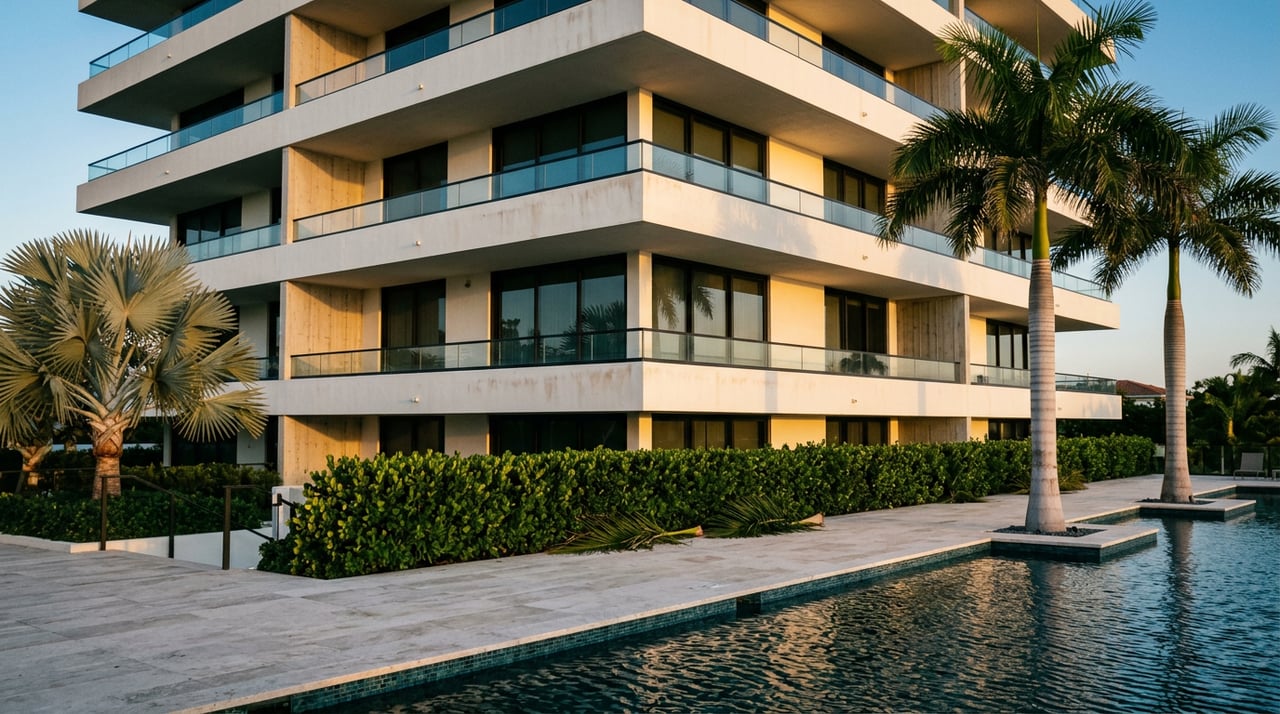
Boca Raton's newest entrant is instructive. In March 2026, the City Council unanimously approved an eight-story, 76-unit condominium tower on the grounds of the Boca Raton Resort, at 501 E. Camino Real, replacing a golf-course maintenance yard rather than an aging structure. New buildings like this one don't carry a deferred-maintenance bill because there's nothing to defer yet.
Blend those two populations into a single "median condo price" and you get exactly what the citywide data shows: a number that goes down even while individual buyer demand for the newest towers is climbing.
Price Per Square Foot Isn't the Full Price
The instinct when comparing two condos is to normalize for size and look at price per square foot. In Boca Raton right now, that comparison is incomplete without a second number: the building's reserve funding percentage, meaning what portion of the money needed to fully fund a structural component, like the roof or the parking garage, is actually sitting in the account today relative to that component's remaining useful life.
Two units can carry the same price per square foot and have entirely different total costs of ownership, because one building is sitting on a fully funded reserve and the other is one board vote away from a five-figure assessment. Since House Bill 1021 took effect, associations with 25 or more units are required to post their governing documents, budgets, and reserve studies online, which makes this comparison far easier than it was even two years ago. Smaller boutique buildings under that unit threshold don't carry the same posting obligation, so a buyer looking at one of Boca's smaller oceanfront addresses should plan to request the SIRS and reserve study directly rather than assume it's published.
There's a financing wrinkle coming, too. Fannie Mae and Freddie Mac issued updated condo project standards in March 2026 that raise the required reserve allocation from 10 percent to 15 percent of a building's annual budgeted assessment income, effective January 4, 2027. Associations that were struggling to meet the old 10 percent bar now have a shorter runway to a stricter one, according to analysis from Bilzin Sumberg. For a buyer planning to close in early 2027, that's not a distant policy detail. It's a variable that can affect whether conventional financing is even available on a given building.
Before You Compare Two Listings, Pull Three Documents
- The Structural Integrity Reserve Study and its funding percentage. Ask not just whether the SIRS exists, but what percentage of full funding each major component carries relative to its remaining life.
- The building's Certificate of Occupancy year. This is the fact that determines whether a building falls under the 25-year coastal trigger or the standard 30-year rule, and it's available through the Palm Beach County Property Appraiser's public parcel records.
- Any levied or pending special assessment, including payment terms. Boards can now fund structural work through loans or lines of credit rather than lump-sum cash calls, so ask whether an assessment is a single bill or spread over years.
Buyers who treat these three documents as standard due diligence, the same way they'd treat an inspection report, are the ones who avoid discovering a $60,000 surprise after closing. Our Boca Raton neighborhood guide and buyer's guide both walk through how to build that request into an offer before it's signed. For buyers and investors weighing whether an older, discounted building represents genuine value or a deferred liability, our team at TDS Realty Advisors applies the same underwriting lens we use on development acquisitions to individual condo purchases.
Frequently Asked Questions
Does this apply to buildings under three stories? No. Florida's SIRS and milestone inspection requirements exempt single-family, two-family, three-family, and four-family dwellings of three or fewer habitable stories.
What if a building hasn't completed its SIRS yet? As of today, any qualifying association that existed before July 1, 2022 and hasn't completed its study is technically out of compliance with a deadline that passed December 31, 2025, unless it qualifies for the narrow extension tied to a 2026 milestone inspection. That's a reasonable question to ask a listing agent directly.
Does new construction avoid all of this? New buildings avoid the deferred-maintenance gap, but they don't avoid the underlying law. Any condominium three stories or taller needs a SIRS on file regardless of age, so even a tower delivered in 2026 will have one, it will simply start from a funded position rather than a depleted one.
The median on a portal search will tell you what Boca Raton condos cost on average. It won't tell you which building you're actually buying into. That distinction is worth a conversation before it's worth an offer. The Schirripa Group works through building-level reserve health and assessment history as a standard part of every Boca Raton condo search we run for clients, so reach out when you're ready to look past the sticker price.